Belonging to a Country because one adheres to “Patriotic Values.”
“Joining” the military because of an adherence to patriotic intentions.
BUT
When you join the military, you “more than” belong.
You are OWNED by the Military.
Your purpose and meaning are assured.
But, at what cost?
“Mission over the Man.”
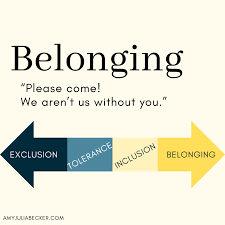
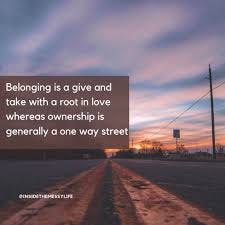
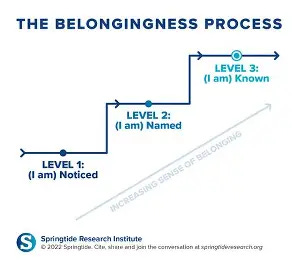
The American Psychological Association Dictionary defines “belonging” as (n.) the feeling of being accepted and approved by a group or by society as a whole…
Belonging (a social term) is when we identify with and are accepted by a group of people.
VERSUS
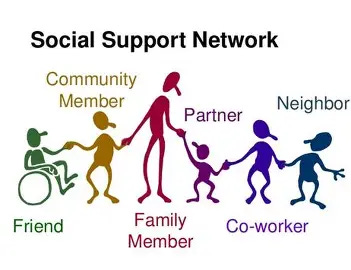
Social Support (a scientific term) or the perception of feeling cared for.
Being able to get help from, and, to be part of a social group or network.
There are (belonging) institutions,
and there are “nature-generated” belonging circumstances.
Both evolve, growing “tighter” or “loosening” with time:
Marriage - social
Parents - nature
Biological siblings - nature
Religious Identification - social
Fraternities - social
Biological siblings seem to belong.
You don’t choose your siblings or your biological parents,
But you belong to one another for life.
Whether you like it or not.
You may choose your marital or life partner. However, your choice is sometimes influenced by a reference group of belonging, such as your parents and/or family, friends, culture, and associations.
Belonging varies across persons, from complete disconnection to being so tightly bound that you live together.
Belonging interacts with natural selection, including in “mimesis,” which I have described earlier.
Belonging is mimetic.
Is there a downside
to belonging?
Yes
One is “loss.”
Or when the “belonging-bond” is broken (or ends).
Some speculate that it is worse, emotionally, to belong and lose belonging
Some feel belonging endingmore strongly than others.
Some communicate better in belonging relationships than others.
This is due to:
Personality
Disposition
Ideology
There are groups of people who might be considered “Loners.”
Are Loners unhappy?
Not always.
“Loners” can be characterized as:
persons who prefer not to associate with others:
How would you respond to this statement:
"My interest in birdwatching has made me a bit of a loner."
Is birdwatching a reason this person is a “loner?
People vary in their desire to belong versus their preference for a solitary life.
This is where “PERSONALITY” comes in.
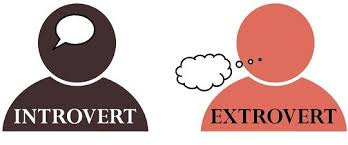
“Extroversion” and “Introversion”
Extroversion/Introversion dates back to Carl Jung in the 20th century.
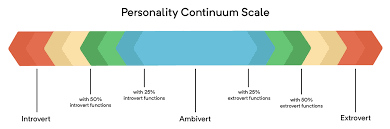
Who viewed the introversion/extroversion dichotomy as endpoints along a continuum of social relationalism.
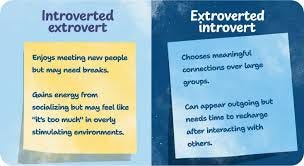
Jung reasoned that all people have some of introversion and extroversion; the relative strength of one or the other in a given individual can be assessed. When the strength of this personality trait is at 50% for each, this person is an “AMBIVERT.”
Are you an AMBIVERT?
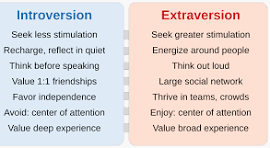
Extroversion is a personal libido focus on external things or social interaction and engagement.
Introversion, in contrast, is a libido energy focused inward, on the self, often manifesting in a need for solitude and personal time, with social and physical stimulation minimized.
Introversion/Ambiversion/Extroversion is central in personality theory.
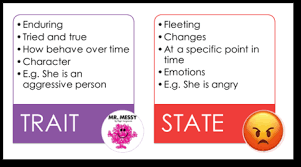
These are personality traits: stable, enduring patterns of thoughts, feelings, and behaviors that characterize individuals in relation to others.
In contrast to
Personality is a “state,” or temporary, short-term, and transient fluctuations in feelings, thoughts, and behaviors, often triggered by emotions or immediate situations. Someone shouts at you and you are now in an angry mood.
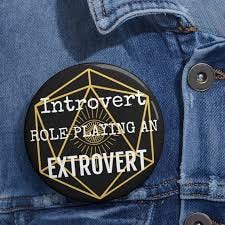
Extroversion and introversion PERSONALITY TRAITS can be modified, temporarily, as in an introvert who takes on a role of group leader and must then act in an extroverted way.
International Personality Item Pool (IPIP) Extraversion Scale
INSTRUCTIONS: The following ten statements describe people’s behaviors.
Select how accurately each statement describes you.
Describe yourself as you generally are now, not as you wish to be in the future.
IPIP OVERVIEW
For each question, there are 5 answers listed below:
Very inaccurate
Moderately inaccurate
Neither inaccurate or accurate
Moderately accurate
Very accurate
Half of the 10 items are scored in reverse. Item number sequence flips from ascending (1 to 5) or descending (5 to 1).
To score this test, add up the 10 item numbers.
The IPIP score range is 10 to 50.
IPIP TEST ITEMS
A. I am the life of the party
Very inaccurate
Moderately inaccurate
Neither inaccurate nor accurate
Moderately accurate
Very accurate
B. I don’t talk a lot.
5. Very inaccurate
4. Moderately inaccurate
3. Neither inaccurate nor accurate
2. Moderately accurate
1. Very accurate
C. I keep in the background
5. Very inaccurate
4. Moderately inaccurate
3. Neither inaccurate nor accurate
2. Moderately accurate
1. Very accurate
D. I feel comfortable around people
Very inaccurate
Moderately inaccurate
Neither inaccurate nor accurate
Moderately accurate
Very accurate
E. I start conversations.
Very inaccurate
Moderately inaccurate
Neither inaccurate nor accurate
Moderately accurate
Very accurate
F. I have little to say.
5. Very inaccurate
4. Moderately inaccurate
3. Neither inaccurate nor accurate
2. Moderately accurate
1. Very accurate
G. I talk to a lot of different people at parties.
Very inaccurate
Moderately inaccurate
Neither inaccurate nor accurate
Moderately accurate
Very accurate
H. I don’t mind being the center of attention
Very inaccurate
Moderately inaccurate
Neither inaccurate nor accurate
Moderately accurate
Very accurate
I. I don’t like to draw attention to myself.
5. Very inaccurate
4. Moderately inaccurate
3. Neither inaccurate nor accurate
2. Moderately accurate
1. Very accurate
J. I am quiet around strangers.
5. Very inaccurate
4. Moderately inaccurate
3. Neither inaccurate nor accurate
2. Moderately accurate
1. Very accurate
What is your total score ____ ? (sum of the 10 items).
Higher scores are indicative of higher extroversion.
INTERPRETATION
High Score: A score above 35-40 indicates an individual is outgoing, energetic, and thrives in social interactions. (extroverted).
Low Score: A score of 20-25 indicates a preference for solitude, introspection, and reserve. (introverted).
A score lower than 20 might indicate pathology such as depression or social phobia.
Females generally score higher on extroversion than males.
The older one gets, after 50 years, the more introverted one becomes,
this is without respect to sex, education, race, or almost any other characteristic.
People who report lower self-esteem tend to report higher levels of introversion.
The Case of Marvin
I saw Marvin around a decade ago. The length of therapy was about 3 years.
Marvin stopped because he enlisted in the Army and was deployed overseas.
This was before the advent of telemedicine; our sessions were in-person.
Marvin was a young, Caucasian male by appearance. He was quiet by disposition, 24 years old when I saw him, and still living with his mother. He was well-dressed for our visits. Marvin said he was working on his online associate’s degree in mathematics at Snow College.
Marvin’s parents were divorced. They split when he was 11 years old. His father was a computer engineer. Marvin said his Dad was eccentric and a recluse. At the time of their divorce, the father landed a job in Los Angeles, CA, and wanted to move the family to CA. Mom was reluctant to go; so, over time, Dad became dissatisfied with “everything,” including Mom.
One day, Dad announced he had met someone else and wanted a divorce. Marvin recalled that his Mom was dumbfounded, depressed, and lost afterward. She was a stay-at-home Mom with no skills or desire to work and two young children.
Marvin said that Mom became depressed for some months, staying in her room most of the time, and it was at that time that their lifestyle deteriorated to the point where they were barely able to afford their apartment rent.
Marvin lived with his mother and his sister, Carolee, as Mom kept the kids post-divorce; Dad moved to Los Angeles, CA, with his girlfriend, and began working for one of the many tech companies and living a “Bohemian” existence with his girlfriend. Dad would send intermittent child support and alimony to Mom.
Marvin visited Dad a few times and learned that his Dad had enlisted in the military, and this is where Dad recalled learning “how to work with others.”
Why was Marvin coming to see me?
Marvin was not able to answer this question, other than to tell me that it was to stop his mother’s constant nagging of him about her belief that Marvin needed mental health therapy.
Marvin did not readily divulge information; in fact, for the first four sessions, I had to drag the details out of him. If I let Marvin sit in silence, he would simply sit quietly, almost in a hypnotic trance, unfazed.
Marvin said that his mother thought he was “lazy” and a “loner.” Marvin disagreed with this POV, saying that he simply liked working with things, computers, more than people.
His mother would frequently ask Marvin if he had a personality.
Marvin did not want to work and was completely content to stay in the basement (where he had lived since childhood), limiting his interactions to two friends, both very similar to him in disposition and interests. Playing computer games was constant for Marvin.
It was about 3 months into therapy that Marvin divulged he had a girlfriend. Her name was “Candy,” short for “Candice.” He showed me her picture. She was an attractive young woman with an endearing smile, but she was dressed in goth, face painted white, so it was difficult for me to discern all her features.
I wondered why Marvin waited so long to tell me about the girlfriend. I soon discovered that “Candy” was Marvin’s sister’s best friend. For Marvin, it was a short relationship, lasting about a year until, according to Marvin, “Candy ended it.”
Marvin said his sister was Marvin’s exact “opposite.” An outgoing, somewhat crazy female (from Marvin’s POV) who lived a quasi-transient life since 16 y/o, moving from place to place with friends, staying in hostels, squatting in homes, sometimes living on the street, frequently eating out of dumpsters, and usually doing it with friends.
Marvin called her “a party girl.” He said, “Doc, you should be seeing her, not me. She’s the one who needs help!”
Marvin was attached to his sister, but he detested her behavior and struggled to appreciate her POV. Marvin figured she would come to a bad end, and he worried that he could not prevent it. Marvin reasoned that he attached himself to “Candy” to stay close to his sister.
Marvin’s relationship with “Candy” was unusual. She eventually left Marvin because he said Candy told him he was unwilling to “do things.” By this, he meant to engage in sex. Marvin preferred a social relationship with Candy versus a sexual one. As the sessions progressed, Marvin divulged a deep fear of intimate sexual relationships. He had experienced casual sex a few times, paid for it once, but sex with a girlfriend who loved him seemed overwhelming. “Too much stimulation.”
From one early social girlfriend experience, Marvin concluded that he was happiest when alone, although when he was alone for long periods, his mood dropped, and he would seek solace from his mother, who was always willing to understand Marvin’s unique antisocial proclivities.
I tell this much of the case to highlight a person who was one of the more “introverted” individuals I have encountered.
Marvin’s introverted propensity eventually became a risk for psychopathology.
By diagnostic standards, Marvin met the criteria for Social Phobia:
I suspect his Dad may have had the same symptoms and/or traits.
Social Phobia defined: “…persistent fear of one or more social or performance situations in which the person is exposed to unfamiliar people or to possible scrutiny by others. The individual fears that he or she will act in a way (or show anxiety symptoms) that will be embarrassing and humiliating.”
anxiety specific to social settings… a person feels noticed… scrutinized.
In an adult, this could include a first date, a job interview, or meeting someone for the first time…
… an individual will fear that they will display their anxiety and experience…rejection
social interaction will consistently provoke distress…
social interactions are either avoided, or…reluctantly endured,
…the fear and anxiety will be grossly disproportionate to the…situation,
the fear, anxiety…around social situations will persist for six months…
cause…distress and impairment of functioning in…occupational functioning
the fear or anxiety cannot be attributed to a medical disorder, substance use…
Question1: Is Marvin experiencing Introversion, Social Phobia, or both?
Question2: How might Marvin’s POV and/or Diagnosis impact his future?
Question3: How would you treat Marvin?
I leave these questions for you to ponder. I am at the end of my page length for this blog. If I reach 200 readers, I will finish the Marvin vignette and describe how I approached these three questions with Marvin, my introverted client
AFTER THE SESSION BLOG is a reader-supported publication. To receive new posts and support my work, consider becoming a free or paid subscriber.